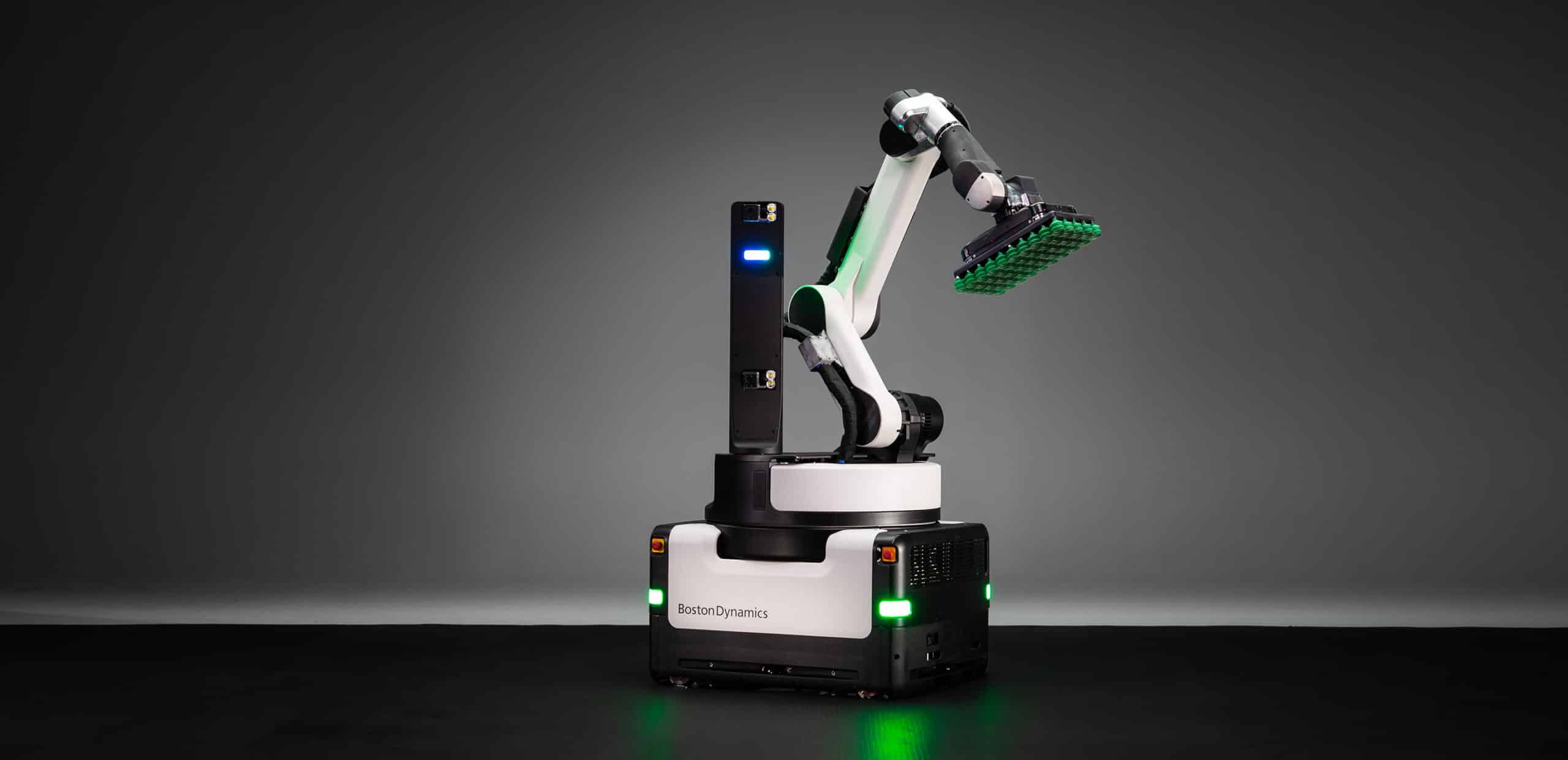
Image credit: Boston Dynamics. Official Stretch studio product image linked from the current warehouse-platform page. Image collection path: March 2026. Capture date and camera provenance are unconfirmed. Image source (opens in a new tab)
A mobile case-handling robot with distinct unloading and case-picking applications.123
Before you choose
What work is Stretch designed to do?
Stretch is a mobile warehouse robot for moving cases. Boston Dynamics describes trailer and container unloading, plus a separate case-picking application that assembles palletized orders. It is a logistics system to compare against a defined work process. It is not a humanoid or a domestic helper, and one application’s equipment should not be assumed to cover the other.
The unloading material lists cases up to 50 lb, but that maximum does not establish compatibility with every carton, packing material or grip surface. The FAQ describes hundreds of cases per hour depending on the container and cases. Use representative loads in a site trial and agree how damaged, awkward or missed cases will be handled.
Case picking is a separately described application. Its claims include pallet building up to 1.8 metres and warehouse-management-system integration through Orbit. Those claims do not establish that an unloading-only or older installation has that equipment or software. Ask the supplier to name the application and demonstrate the complete order flow with your system.
Boston Dynamics advertises up to 16 hours for both named applications. The case-picking material also says recharging takes under two hours with its Fast Charger. These are configuration-specific maker claims, rather than guaranteed productive uptime. Match the trial to the planned box mix, shift and charging opportunity, including stops and operator recovery.
How much setup, training and service should we plan?
The maker says operation can begin in as little as five days after delivery depending on site configuration, and new operators can be trained in two days. These are conditional estimates. Stretch Care describes support, repairs and scheduled maintenance. Confirm site work, training responsibilities, local field-service coverage and response terms in the project proposal.
The official material offers a sales enquiry, without a verified complete-system price for your site. Orbit’s Stretch tools use unloading metrics and images, while exact retention, remote-access and deletion terms remain unestablished. Ask the proposal to cover those terms alongside installation and support. The Spot privacy notice does not automatically govern Stretch.
Stretch addresses a familiar part of getting goods to customers: repeatedly moving boxes through a warehouse. Boston Dynamics offers the platform for trailer and container unloading and now also describes a case-picking application that builds palletized orders. These are workplace systems to assess against a logistics process, rather than household helpers.123
Check the incoming loads
For unloading, the question is how well the robot fits the incoming loads. Boston Dynamics lists cases weighing up to 50 lb and runtime of up to 16 hours for its unloading application. Its FAQ describes throughput as hundreds of cases per hour, depending on the container and cases. A single headline speed would conceal those differences.124
Building an order needs its own configuration
Case picking has a different purpose: assembling an order from stored boxes. Boston Dynamics says this configuration can build pallets up to 1.8 metres high and connect to a warehouse management system through Orbit. Those capabilities belong to the case-picking setup, and should not be assumed to arrive with every unloading installation.3
For case picking, Boston Dynamics advertises up to 16 hours of battery life and recharging in under two hours with its Fast Charger. A buyer should match those claims to the intended shifts and charging opportunity. Long battery endurance and uninterrupted productive work are separate things to demonstrate during a trial.3
Allow for the site and the operators
The maker says a robot can be operational in as little as five days after delivery, depending on the existing site, and that new operators can be trained in two days. Those are conditional estimates. The practical discussion should cover the actual loading area, traffic, box mix and people responsible for starting, stopping and recovering the process.4
Stretch Care describes technical help, repairs and field service, software improvements and scheduled maintenance. The service proposal matters alongside the robot: who comes to the site, which parts are covered and how long could the operation wait? The public description does not establish an identical service entitlement in every country.5
Include data and service in the proposal
Orbit's Stretch tools use unloading metrics and images to explain trailer conditions and performance. That makes data access part of procurement. Ask where the images are held, which staff or service teams can see them and when they are deleted. The Spot privacy notice should not be assumed to answer those questions for a Stretch contract.6
Current official pages direct buyers to sales; they do not establish a complete-system price for a specified site. Request a proposal that names the application, installation, software, training and support. For a reader following home robotics, Stretch offers a useful example of automation built around a specific job with measurable working conditions.153
Current platform spans two named applications. No public retail price or global stock promise. Source observations were recorded 2026-10-26. They are reused here without a new retrieval or hardware test.
Unloading configuration only; site suitability still requires assessment. Source observations were recorded 2026-10-26. They are reused here without a new retrieval or hardware test.
Current case-picking configuration; never backfill 2021 prototype or all unloading units. Source observations were recorded 2026-10-26. They are reused here without a new retrieval or hardware test.
Explicitly excludes Spot home/child use. Deployment/training times are conditional maker estimates. Source observations were recorded 2026-10-26. They are reused here without a new retrieval or hardware test.
Support, field repairs, updates and scheduled maintenance; commercial SLA/pricing unspecified. Source observations were recorded 2026-10-26. They are reused here without a new retrieval or hardware test.
Confirms image and workflow data; not a complete Stretch-specific retention agreement. Source observations were recorded 2026-10-26. They are reused here without a new retrieval or hardware test.