Three configurations to keep separate
The configuration page checked on October 26, 2026 lists 30 degrees of freedom for Basic and 52 for both development versions. Bipedal Development is 175 cm tall and 75 kg; Wheeled Development is also 175 cm tall but weighs 135 kg. Those are different platforms to accommodate and move around a workplace.2
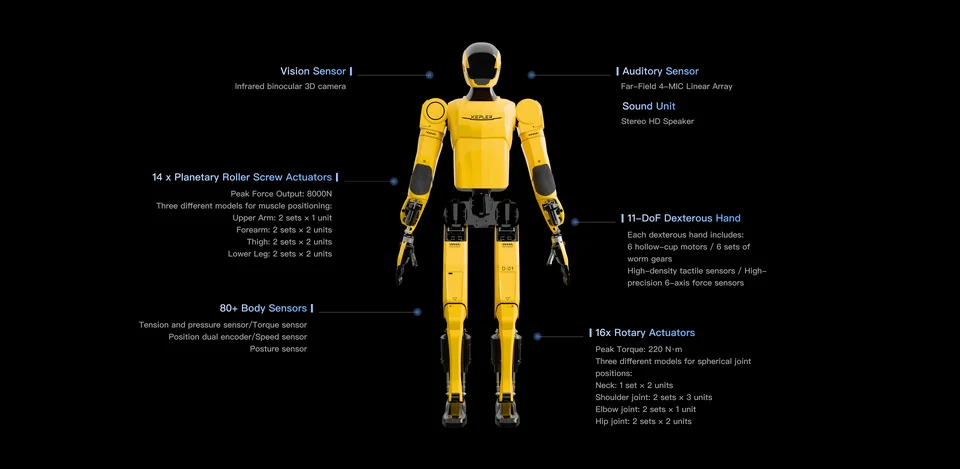
The development configurations list 100 TOPS of computing, without identifying the processor here, and hands with 11 degrees of freedom each and 25 tactile points per finger. Basic’s computing remains unresolved: its banner says 100 TOPS, while the comparison table shows a dash. Obtain a configuration-specific answer before choosing Basic for a project that depends on onboard computation.2
Kepler describes hybrid linear roller-screw and rotary actuation. Its product page advertises dual-arm handling of 25 to 30 kg, eight hours of endurance and a one-hour charge time. The configuration, workload and charging conditions are not specified sufficiently to make those guarantees for every K2 edition or task.62
For someone planning a real deployment, ask for the same object, distance and pace used in the proposed job. Include the time needed to reposition the robot, recover a dropped item and recharge. A working day is a sequence of tasks and interruptions, so the most helpful demonstration shows that sequence rather than a single lift.2
From demonstrations to an offer
Kepler reported an eight-hour demonstration at WAIC on July 27, 2025 and announced customer shipments in September 2025. Its August 1, 2025 presale release gave a lineup starting price of CNY 248,000, without allocating that floor to an exact edition or complete international package. Request a current price for the chosen configuration, destination and support arrangement.45
The configuration table checked on October 26, 2026 lists a 90-day lead time, remote support for all three versions, an eight-month warranty for Basic and 12 months for the development versions. Training and on-site support are optional for the development models. Obtain written terms for the destination and package, including what an acceptance test covers.2
Development access also changes the ownership commitment. If your team will write the application, ask which controls and examples are included and who maintains the software after a change. If you expect a finished system, ask the supplier to name the task it will deliver and the support available when performance falls short. Sensor-data handling and remote-service access should be part of that discussion.2
Where it fits for a household reader
K2 is an industrial and development platform; Kepler describes household services as a future direction for the company. Its significance is the attempt to connect humanoid movement with useful work. For a family, the practical next step is to follow a specific task, such as carrying items between storage and a work surface, and wait for an offer that explains the setup and supervision it requires in a home.21