Menu

PUDU D7

Pudu RoboticsEditorial review pending

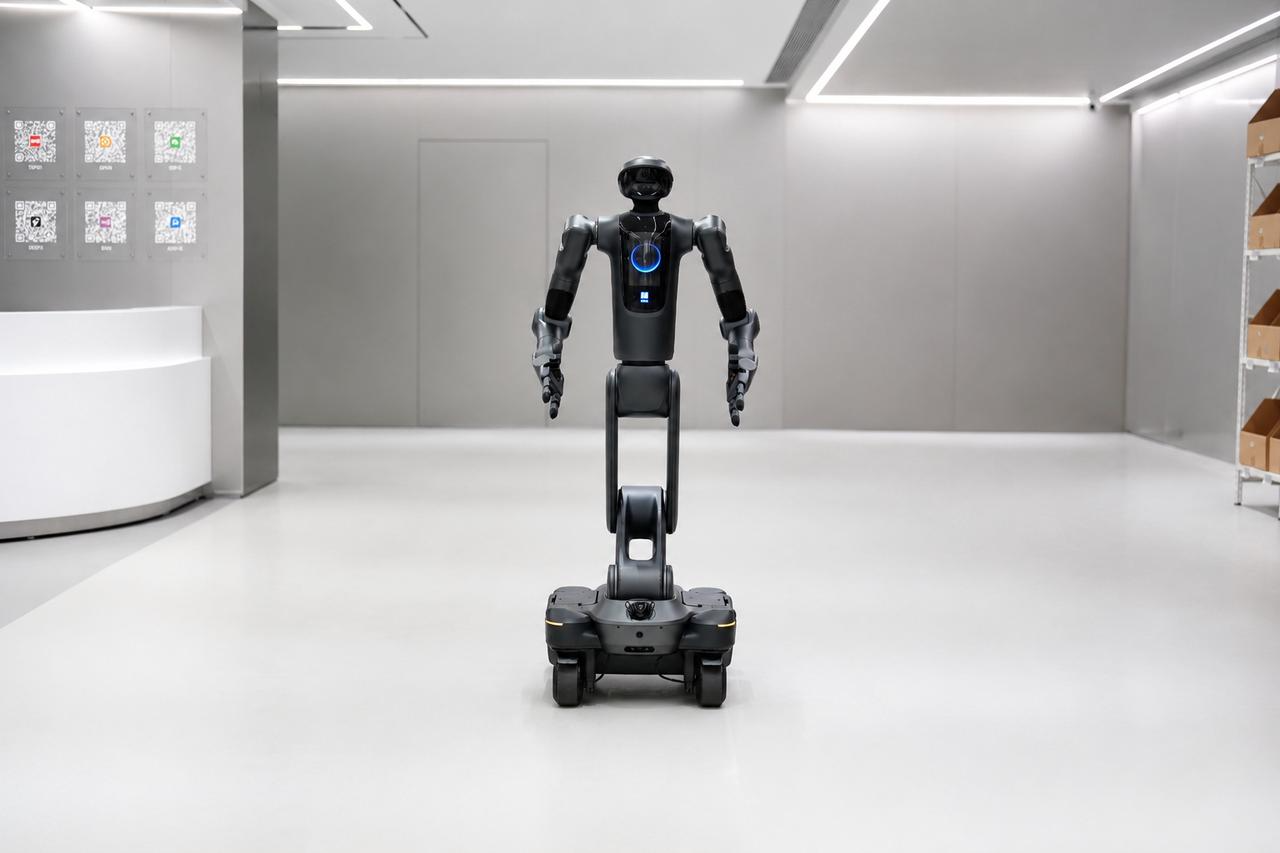
Official image of the June2026 PUDU D7 standing on its wheeled chassis in a facility.

Image: Pudu Robotics. Official Pudu Robotics product image of the industrial D7 from its June1,2026 announcement. Camera origin and capture date are unestablished. Image source (opens in a new tab)

D7 combines an upper body and arms with a mobile base, with distinct 2024 and 2026 generations.231

Before you choose

Is D7 the two-legged Pudu humanoid?

No. D7 is a wheeled semi-humanoid. The June 2026 industrial version has a folding lower body and wheeled chassis. D9 is the separate bipedal program. Their movement and generation-specific hardware should not be combined.

Source(opens in a new tab)Source(opens in a new tab)

Do the 2024 size and joint figures describe the 2026 D7?

That is not established. The original announcement described 165 cm, 45 kg and 30 degrees of freedom, expandable to 50 with a dexterous hand. The June 2026 announcement describes a new industrial platform without a complete matching hardware table. The old figures remain historical.

Source(opens in a new tab)Source(opens in a new tab)

What do 14 kg and 2 metres mean?

Pudu states up to 14 kg payload and up to 2 m operating height for the 2026 platform. Operating height describes its working reach or level, not standing height, and the payload is not a per-arm rating. Request a demonstration with the actual object, shelf and route.

Source(opens in a new tab)

Does continuous operation mean a 24-hour battery?

No. The cited announcement describes automatic battery removal, replacement and charging as part of keeping a workflow running. It does not establish single-charge runtime or guaranteed uptime. Ask about the swapping equipment, spare batteries, space and recovery procedure.

Source(opens in a new tab)

What should an industrial trial cover?

Use one complete material-handling task, including a blocked route or misplaced object. The maker describes tactile sensing, front and rear LiDAR, PuduFM 1.0 and operational data collection. Ask what is recorded, who can access it and how supervision and recovery work at the proposed site.

Source(opens in a new tab)

Can a household order a supported D7?

The cited sources establish an industrial announcement and inquiry context. It does not establish a current household price, regional delivery package or maintenance and data agreement. Obtain terms for the exact revision rather than treating Pudu’s separate delivery-robot business as evidence of D7 readiness.

Source(opens in a new tab)

The robot and the job

D7 is Pudu's semi-humanoid: a robot designed to move through a workplace and use its arms once it gets there. The June 2026 version targets industrial jobs such as handling materials and replenishing shelves. Its wheeled base is an important part of its identity, and it should not be confused with the company's two-legged D9.314

Keep the generations separate

Pudu introduced the first D7 in September 2024. That announcement described a 165 cm, 45 kg platform with 30 degrees of freedom, expandable to 50 with a dexterous hand. It anticipated full commercialization in 2025. An anticipated date does not establish that every region later received the same configuration or that the original design shipped unchanged.2

The new industrial D7 was announced on June 1, 2026. Pudu describes a folding lower body, a wheeled chassis and a head containing cameras. This is the generation emphasized here. The original weight, body height and joint count remain historical figures until a matching specification sheet identifies them for a newer machine.13

The job Pudu is targeting

For the 2026 platform, Pudu states a payload of up to 14 kg and an operating height of up to 2 m. The latter describes where it can work, not how tall it stands. The company describes dual-arm handling, tactile sensing and front-and-rear LiDAR, with PuduFM 1.0 coordinating the work. These are manufacturer claims for industrial applications, not results from our own testing.1

Pudu also describes automatic battery swapping. That can be relevant to keeping an industrial workflow running, but it should not be read as a battery lasting 24 hours on one charge. A buyer would still need to understand the swapping equipment, spare batteries, charging space and the time taken to recover from an interrupted task.1

A useful way to evaluate it

Choose one actual job before requesting a demonstration: moving a particular box from a shelf onto a cart, for example. Ask to see the complete sequence with the same shelf height, object weight and aisle space you expect to use. Include a blocked route and a misplaced box. That gives the payload and operating-height claims a practical meaning.1

The 2026 announcement describes operational data collection to improve the robot's models. Ask what is recorded, whether it leaves the site, who can access it and what happens when connectivity is unavailable. Those questions belong alongside maintenance responsibility, software fees and support response times in a proposed purchase.1

A current household offer is not established here. D7 is best understood through its industrial use case and the exact seller-supported configuration. A restaurant delivery robot carrying the same company name is not evidence that this newer platform has the same price, support arrangements or readiness.1Inferred

Explore further

Sources and notes

  1. 1. PUDU D7 next-generation industrial launch

    Dual-arm manipulation; data; LiDAR; battery swapping Up to 14 kg payload, operating height up to 2 m, not standing height. Autonomy and continuous operation are maker claims. Source observations and verification dates are retained from the prepared packet. No new retrieval, installation or hardware test was performed for this staging packet.Inferred

    Evidence checked: 2026-10-26

  2. 2. Original PUDU D7 launch

    Semi-humanoid definition; specifications; commercialization anticipated 2025 Original 45 kg/165 cm/30DOF platform, not 2026 version.2025 commercialization was a forecast. Source observations and verification dates are retained from the prepared packet. No new retrieval, installation or hardware test was performed for this staging packet.

    Evidence checked: 2026-10-26

  3. 3. D7 industrial design

    Head cameras; folding lower body; guide-wheel chassis Confirms wheeled industrial semi-humanoid, not biped; no household safety certification. Source observations and verification dates are retained from the prepared packet. No new retrieval, installation or hardware test was performed for this staging packet.

    Evidence checked: 2026-10-26

  4. 4. PUDU D9 global product catalog

    Product overview and two disclaimers 65 kg/42DOF remain visible in indexed page, while April 2026 article says 58 kg. Contract determines customer features and shipped version. Source observations and verification dates are retained from the prepared packet. No new retrieval, installation or hardware test was performed for this staging packet.

    Evidence checked: 2026-10-26

What does degrees of freedom mean?