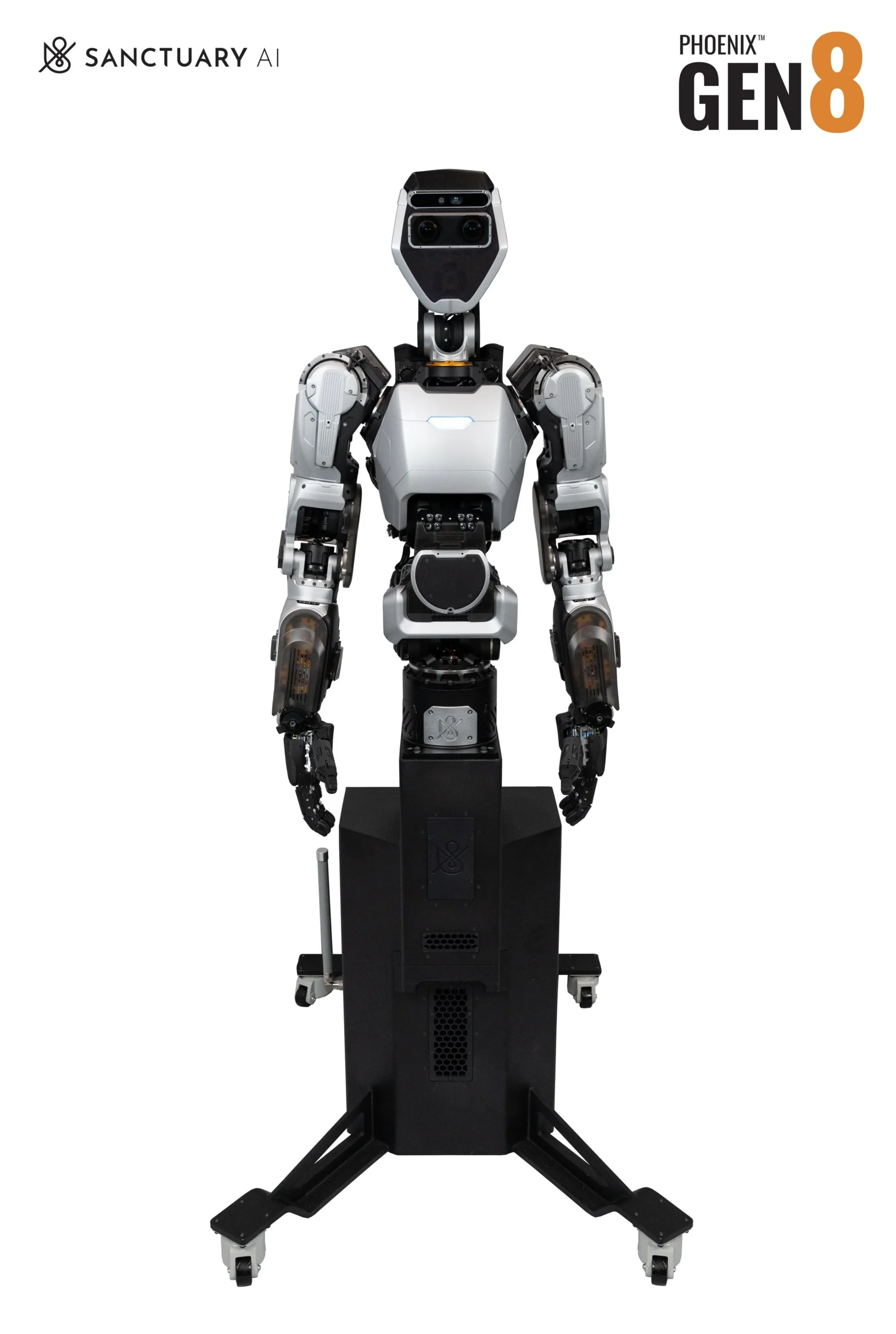
From legged prototypes to a wheeled platform
Sanctuary introduced Phoenix with its sixth-generation robot on May 16, 2023. The company described a machine standing 5 ft 7 in, weighing 155 lb and carrying a maximum 55 lb payload, with a stated maximum speed of 3 mph. Those specifications describe that historical Gen6 machine.16Reported
The seventh generation brought more motion in the wrists, hands and elbows, miniaturized hydraulics and improved visual and tactile sensing. Generation 8 then used a wheeled base, with camera and telemetry changes intended to collect better training data. Following the generation reveals what Sanctuary was trying to improve: both how the robot moves and what it can learn from its work.23
The work behind the body
Carbon is the control software introduced with Phoenix. Sanctuary described a combination of AI task planning, human supervision, remote operation and fleet management. For a task such as placing an awkward object, the useful question is how these parts work together: what the robot decides, when a person helps and how an unsuccessful attempt becomes useful training data.1
The program also has a predecessor worth distinguishing. Sanctuary says its fifth-generation robot entered a commercial deployment in January 2023, before the Phoenix name was introduced. That earlier deployment is part of the company’s development history, rather than a shipment claim for Gen6, Gen7 or Gen8.216
In June 2026, Sanctuary broadened its strategy to AI running on existing industrial robot platforms. Its roadmap presents industrial-arm solutions as deploying, hydraulic hands as in development, mobile platforms as approaching pilots and industrial humanoids as future work. Phoenix sits within that larger effort to make physical handling useful across different machines.54
Following progress in useful handling
For a research or industrial project, start with the exact hardware generation and the task it would perform. A proposed workcell needs its own dimensions, load rating and operating limits. The Gen8 announcement does not supply a complete specification or a Phoenix-specific price and delivery package.43
Describe the awkward parts of the job, not just the successful finish: a flexible cable, a partly hidden object or a failed grasp. Ask how much human help is needed, how a new task is taught and who restores the system after a stop. A project agreement should also identify maintenance responsibilities and access to camera and training data.14
For families following home robotics, Phoenix offers a way to understand progress in handling objects. Pick one job, such as putting away toys, then ask whether the demonstrated generation can repeat it with different shapes, how much human help it needs and what happens after a failed grasp. Those answers would matter to a home purchase; Sanctuary’s industrial roadmap does not establish a household offer.14