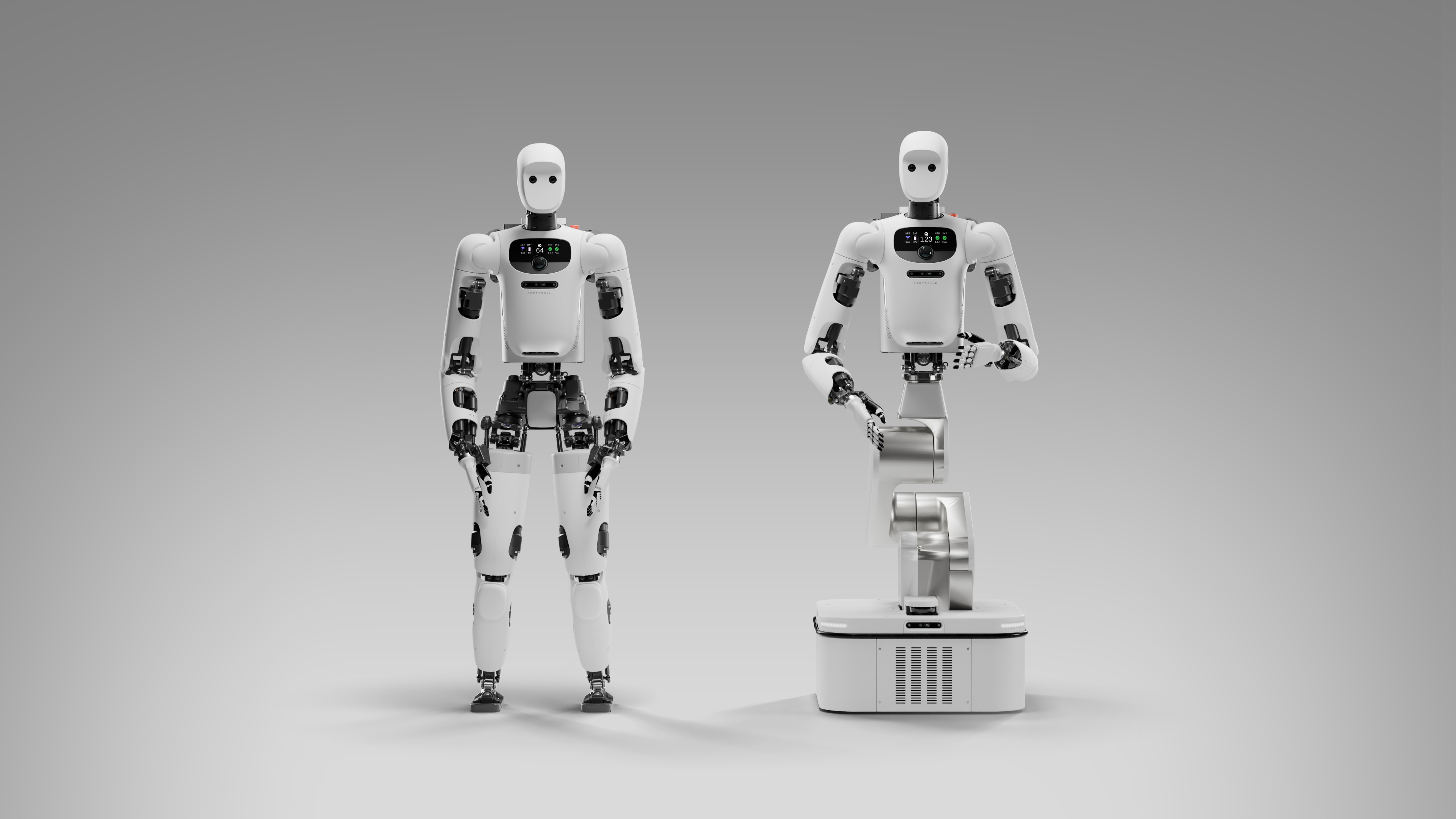
Does the job call for legs or wheels?
Apollo 2 comes in bipedal and wheeled configurations. Apptronik describes the wheeled base as intended to fit existing industrial mobile-robot safety standards, while the walking version lets the company refine walking safety and reliability in more complex environments. Start with the route and the handling task: which movements are needed, where does the robot stop, and what advantage would legs bring?32
The Robot Park announcement describes a mix of teleoperation and autonomous execution in data-collection workflows. It names Google DeepMind as the research partner and Gemini Robotics as the AI models trained with the collected data. It also identifies Mercedes-Benz and GXO as customer sites using these workflows. Apollo 2's role is to gather experience for training and development.2
For a particular task, ask who is controlling the robot, how often help is needed and how an interrupted action is recovered. A training session can combine several operating modes. Those answers will help distinguish a useful supervised trial from the level of operation the business eventually needs.2
The original Apollo figures belong to 2023
Apptronik unveiled the original Apollo on August 23, 2023. Its launch specifications describe a robot 68 inches tall, weighing 160 lb, with a 55 lb lifting capacity and four-hour batteries. They are historical figures for that original robot. Apollo 2 height, mass, payload and per-battery runtime remain unspecified in the current product information.4
Apollo 2's present training role and Apollo 3's planned commercial role should be named separately in any proposal. Ask whether the agreement concerns an Apollo 2 trial or a future Apollo 3 delivery, what functions are included, and which milestones must be met before those functions are available.23
Power and signals around people
For Apollo 2, Apptronik describes swappable battery packs, opportunity charging and tethering. Choose a meaningful trial that includes the power arrangement proposed for the task. Where would a pack be changed or charged, and would a tether suit the route? The supplier needs to provide runtime for the actual configuration and workload.3
Apptronik describes an LED mouth, coordinated lighting, speech and listening, and a chest display showing status, battery and task information. Ask to see the signals people receive when Apollo 2 is waiting, stopping or needs help. The usefulness of those signals depends on whether nearby workers understand them during the intended task.3
Software, working area and support
Apptronik says Artemis coordinates the robot's perception, planning, controls, safety, tasks and interaction. Fleet Connect supports monitoring, task orchestration, deployment and data collection. Ask which services the installation requires, who can assign tasks and what access an operator has when work is interrupted.3
Apptronik describes an impact zone intended to pause Apollo 2's motion and a configurable perimeter zone. Have the supplier explain how those zones fit the actual layout, how passing people affect the task and what procedure restarts work. The proposed operating area needs its own assessment.3
Apptronik has also announced a manufacturing and validation collaboration with Jabil. This provides context for how the Apollo program is being developed and prepared for production.5
What would a useful trial settle?
Use the actual objects and route, include charging and recovery, and identify who provides support. Ask for the exact generation and base configuration, the delivered task functions and the operator help each function requires. A trial is useful when it answers whether that combination fits the work.32
Access begins with a business inquiry to Apptronik. Price, warranty and service-response terms need to be agreed, as do the rules for recordings, remote-operator access, training use and retention. Put these questions into the proposal so the staff, support and data responsibilities are clear before the trial begins.32
Apptronik describes household applications as a potential future direction. Apollo 2's documented role is industrial data collection and training, with Apollo 3 named as the forthcoming commercial product. A family interested in household help should follow that development with the intended home task in mind.12
Original Apollo: historical launch specifications
Apollo · Original Apollo, August 23, 2023 launch · Apptronik original launch announcement
These figures describe the original Apollo at its 2023 unveiling. They do not establish dimensions, load capacity or runtime for Apollo 2 or the future Apollo 3.42
- Original height
- 68 inchesOriginal Apollo launch specification.4
- Original robot mass
- 160 lbOriginal Apollo launch specification.4
- Original lifting capacity
- 55 lbOriginal Apollo launch specification.4
- Original battery life
- 4 hoursOriginal Apollo launch statement.4
Sources and notes
- 1. Apptronik product direction
Apptronik identifies the Apollo platform and describes potential household applications as a future direction.
Evidence checked: 2026-10-25
- 2. June 2026 Robot Park and Apollo 2 announcement
The announcement gives Apollo 2 a data-collection and training role, including mixed teleoperation and autonomous execution. Apollo 3 is described as the forthcoming commercial generation. The wheeled configuration is presented with a safety-design rationale, which is not a certification claim.
Evidence checked: 2026-10-25
- 3. Apollo 2 product information
The Apollo 2 page describes configurations, power options, interaction, software and safety zones. Its information does not establish current height, mass, payload or per-pack runtime. The business proposal needs the configuration-specific specifications, price, service and data terms.
Evidence checked: 2026-10-25
- 4. Original Apollo announcement, August 2023
The original height, mass, payload and battery figures are dated August 23, 2023. They remain historical reference points, separate from Apollo 2 and Apollo 3 specifications.
Evidence checked: 2026-10-25
- 5. Apptronik and Jabil collaboration
The announcement describes manufacturing and validation collaboration. It does not establish completed high-volume delivery of a later Apollo generation.
Evidence checked: 2026-10-25