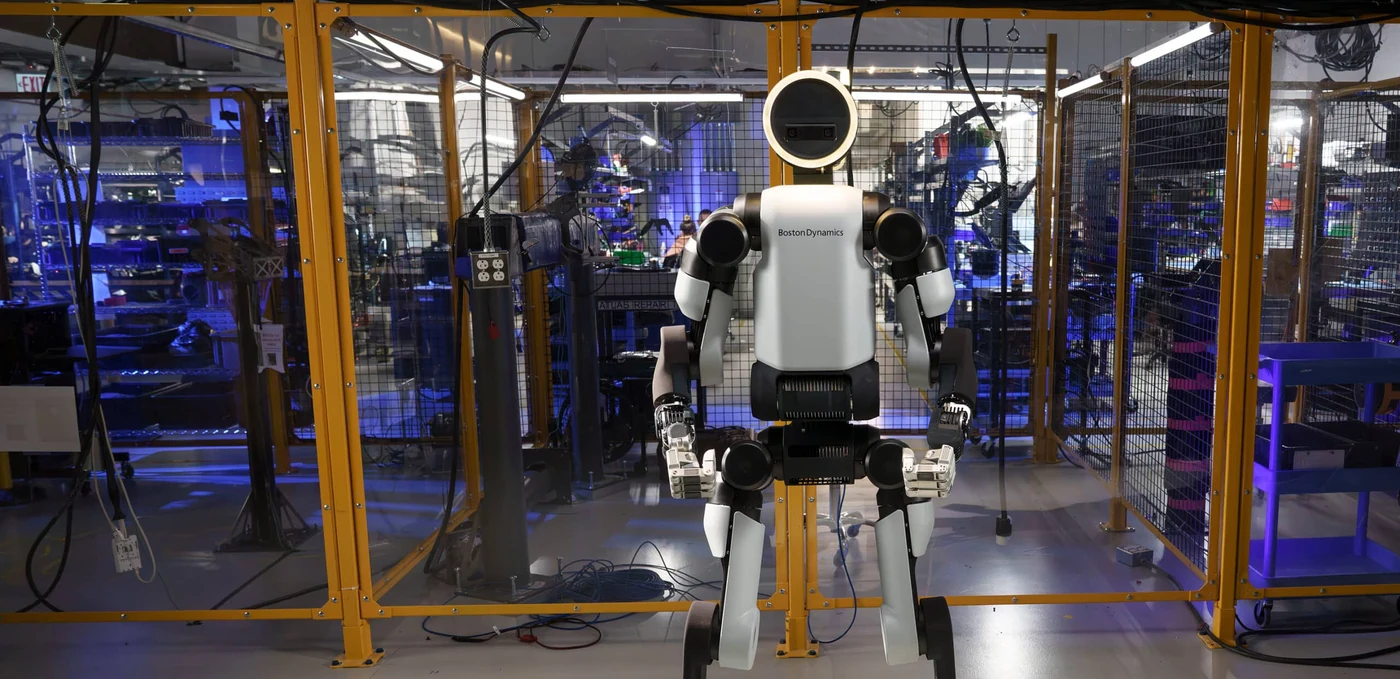
Which Atlas is this?
The electric Atlas family began in 2024, following the hydraulic research robot. The 2026 product version has its own specifications. Those dates describe different steps in the program, so the older electric prototype and hydraulic predecessor need to stay separate when comparing size, lifting capacity or operating time.372
Start with the handling job
Consider a repeated job such as moving a part between two workstations. What is the object, where must it be gripped, and how precisely must it be placed? Boston Dynamics starts customer onboarding with an application evaluation and task-specific training. Those details give the supplier a useful job to assess and the business a way to judge the result.1
Boston Dynamics described parts-sequencing training at Hyundai RMAC in September 2026. Its January launch announcement had named Hyundai RMAC and Google DeepMind as planned fleet destinations for the year. The RMAC account describes a training setting; the January schedule remains a statement of planned deliveries.52
Match the load to the movement
A brief lift and carrying an object repeatedly call for different comparisons. Boston Dynamics specifies 50 kg of instant capacity, 30 kg sustained and 20 kg one-handed. Start a repeated-work discussion with the sustained figure, then ask for an assessment using the actual object, grip and reach. A job that keeps one hand occupied also needs the one-handed limit.6
The October specification sheet describes a robot 1.9 m tall and 90 kg in mass, with 56 degrees of freedom and a 2.3 m reach. Use those dimensions to frame a discussion about the workstation and access around it. The same sheet lists IP67 and operating temperatures from -20 to 40 degrees Celsius; the installation still needs an assessment for its particular environment.6
Plan charging around the work
The maker lists four hours of battery life generally and two hours with heavy lifting. It also lists a three-minute autonomous battery swap and a 1.5-hour charge. Map those separate steps onto the proposed shift: when would a pack be changed, where would it charge, and who handles a failed swap? The job needs a power plan as well as a lifting plan.6
The charger specification lists 110 V as standard and 220 V as an option. Confirm the supplied charger and batteries alongside the site power arrangements. Ask for the complete installation scope, including integration, Orbit software and service, before comparing costs.61
Who runs and supports it?
Atlas supports autonomous operation, VR teleoperation and tablet control. Its hardware includes tactile sensing in the fingers and palm and a 360-degree camera view. For the proposed task, ask which mode is used, when an operator takes over and how work resumes after an interruption.61
Boston Dynamics presents Orbit as the connection between Atlas workflows, fleet metrics and industrial systems. It also describes modular, field-replaceable components and customer self-repair certification. Agree who will monitor the robot, who can repair it and which spare parts will be available at the site.16
Price, warranty duration and robot-data retention terms need to be settled with the supplier. A proposal should explain access to camera footage and teleoperation, use of training data, and the support available when the robot stops. These terms belong alongside the task and equipment specification in the decision.16
Can a household buy one?
Boston Dynamics directs qualified organizations to evaluation and early-adopter discussions, and explicitly excludes individual non-commercial purchasing. For a family following humanoid robots, Atlas offers a view of industrial handling and task training. The available purchasing route is an organizational deployment.14
Atlas 2026 product: body and handling
Atlas · 2026 electric product version · Boston Dynamics specification sheet, October 15, 2026 revision
The maker separates instant, sustained and one-handed capacity. These specifications cover the 2026 electric product, with the October 15 sheet supplying the body and load figures.26
- Height
- 1.9 m2026 product specification.62
- Robot mass
- 90 kgRobot mass, separate from lifting capacity.62
- Degrees of freedom
- 56 DOFMaker count for the 2026 product.62
- Reach
- 2.3 mMaker reach specification.62
- Instant capacity
- 50 kgBrief lifting capacity.62
- Sustained capacity
- 30 kgSustained load specification.62
- One-handed capacity
- 20 kgLoad handled with one hand.62
- Ingress protection
- IP67Maker IP rating for the 2026 product.62
Atlas 2026 product: battery cycle
Atlas · 2026 electric product version · Boston Dynamics specification sheet, October 15, 2026 revision
Battery life depends on the work. The sheet gives a separate heavy-lifting case, while swapping and charging describe two different steps in replenishing power.26
- Headline battery life
- 4 hoursGeneral maker figure; heavy lifting is listed separately.62
- Heavy-lifting battery life
- 2 hoursExplicit heavy-lifting case in the October revision.62
- Autonomous battery swap
- 3 minutesSwap time, distinct from charging time.62
- Battery charge
- 1.5 hoursCharging a pack, distinct from swapping it.62
Sources and notes
- 1. Boston Dynamics Atlas product page
Boston Dynamics describes the industrial application, evaluation process, task training and Orbit integration. Pricing, warranty and robot-data terms need to be agreed for the installation.
Evidence checked: 2026-10-25
- 2. January 2026 Atlas product announcement
January 5, 2026 is the product-version announcement. The Hyundai RMAC and Google DeepMind fleets were scheduled for 2026; that announcement alone does not confirm delivery.
Evidence checked: 2026-10-25
- 3. Boston Dynamics company timeline
The timeline dates the electric Atlas family to 2024. That family date is separate from the 2026 product launch.
Evidence checked: 2026-10-25
- 4. Boston Dynamics purchasing FAQ
The purchasing FAQ excludes individual non-commercial customers.
Evidence checked: 2026-10-25
- 5. Hyundai RMAC training announcement
The September 21, 2026 announcement places Atlas in parts-sequencing training at RMAC. Its context is learning manufacturing tasks.
Evidence checked: 2026-10-25
- 6. Atlas specification sheet, revised October 15, 2026
The revision date printed in the sheet is October 15, 2026, despite the January directory in its URL. The load categories and heavy-lifting battery case belong to this revision.
Evidence checked: 2026-10-25
- 7. Atlas development history
Boston Dynamics describes the transition from hydraulic Atlas to the electric platform introduced in April 2024. Hardware from those earlier stages is historical context.
Evidence checked: 2026-10-25