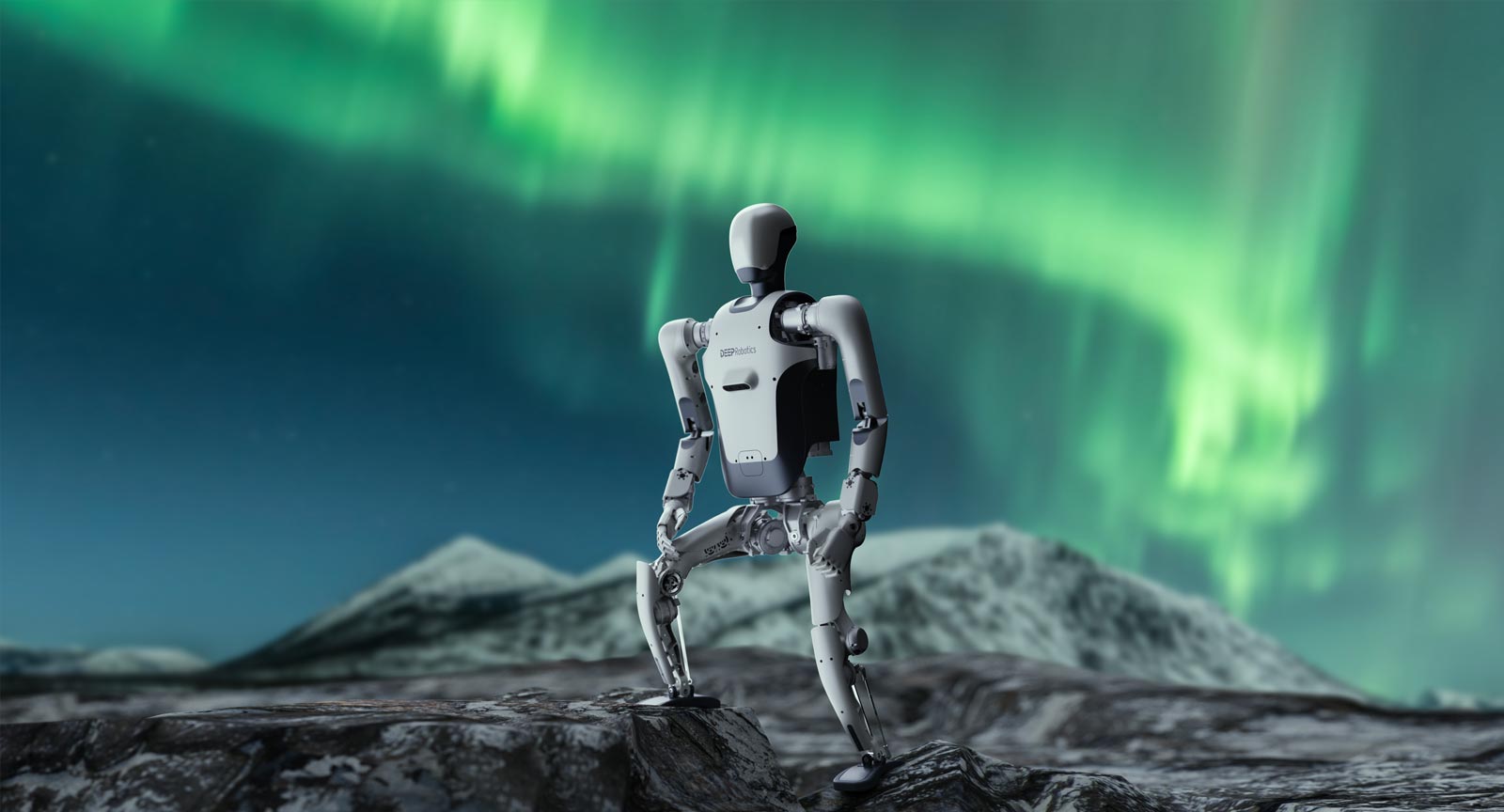
Movement is the central capability
DEEP lists walking above 1.6 metres per second, steps up to 18 cm and slopes up to 25 degrees for DR01. It describes combining the robot's own sensing with information about the environment to control movement across uneven terrain. These are maker specifications and descriptions, not results from our own trials.1
The company also names its J60 and J100 joint families in DR01. For a research team, a useful discussion would connect that hardware to the control access, sensors and simulation tools supplied with the actual machine. A component name alone does not specify the development package.1
DR01 and DR02 are different records
DEEP's September 2026 filing describes DR01 as a research and education platform and dates the second-generation DR02 to October 2025. The newer machine's industrial and all-weather positioning belongs to DR02. It should not be added to DR01 simply because both appear in the DR family.2
The filing describes the DR business as being at an early stage of commercialization. That is more informative than either calling every unit a one-off prototype or assuming general availability. A prospective user still needs DEEP to confirm whether a DR01 configuration is supplied today and under which support terms.21
A useful question for future home robotics
Walking across a difficult surface is an interesting part of the route toward assistance. To evaluate a household use, extend the question beyond movement: what should the robot do when it arrives, what object must it handle and what happens if the route is blocked? Treat those as requirements to demonstrate, rather than chores already included with DR01.1
The public sources used here do not establish a complete household package, price, runtime or maintenance agreement. Research users should request those details for the exact machine and task. A family reader can follow the program's progress without treating a development platform as an available home service.1