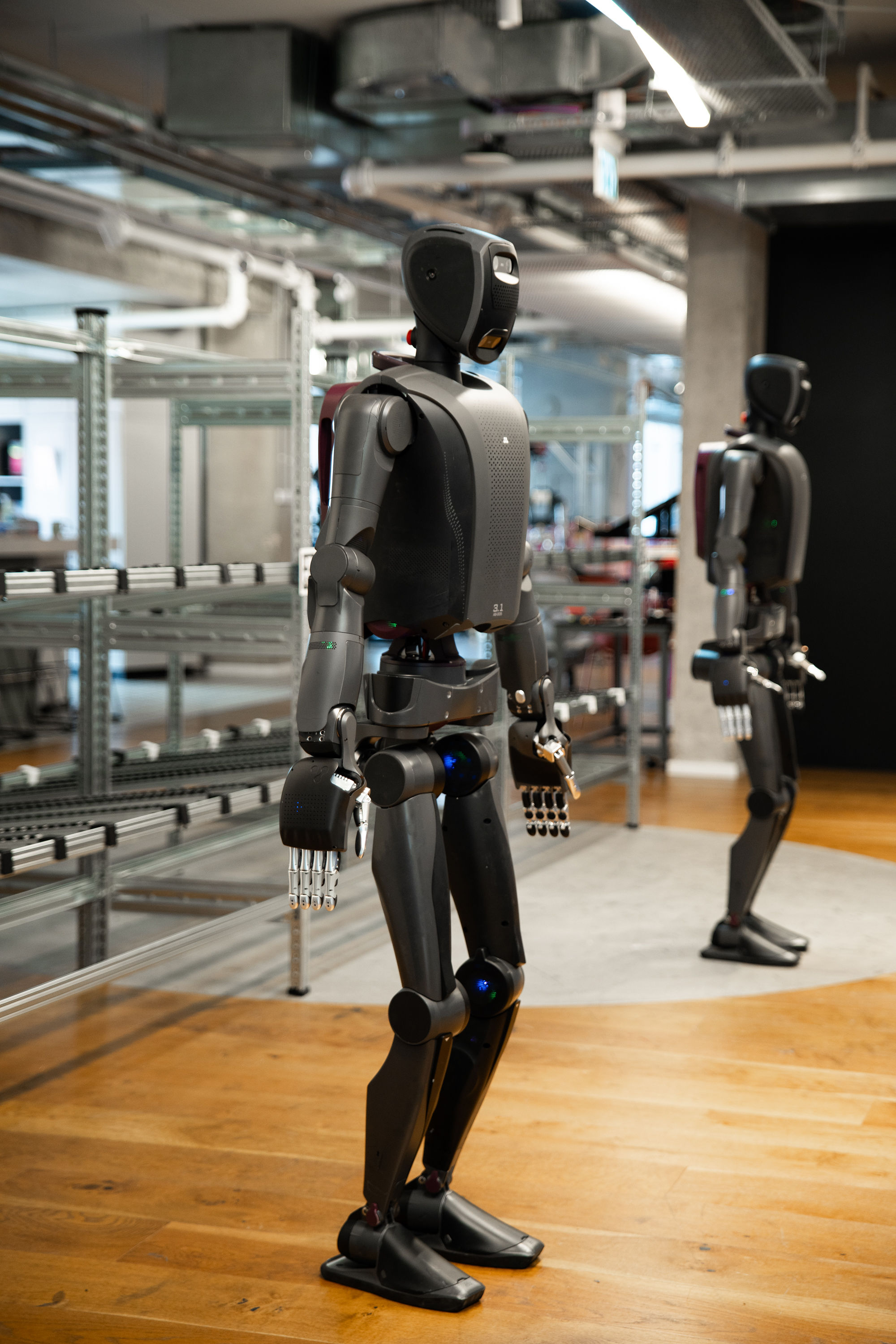
November 2025 maker-labelled V3 warehouse demonstration. Exact unedited Ak0rswEQudE, distinct from edited QumzgbjcjiQ and the 2024 prototype. Autonomy remains the maker claim; no full-run or independent-operation verification.
Video credit: Mentee Robotics. November 2025 maker-labelled V3 warehouse demonstration. Exact unedited Ak0rswEQudE, distinct from edited QumzgbjcjiQ and the 2024 prototype. Autonomy remains the maker claim; no full-run or independent-operation verification. Watch the original on YouTube (opens in a new tab)
Image credit: Mentee Robotics. Mentee Robotics V3 gallery image from its November 2025 warehouse demonstration. Maker-provided image; no independent testing claim. Image source (opens in a new tab)
Mentee's third-generation platform combines a full-size body with an approach based on human guidance and simulation.1
Before you choose
Which MenteeBot generation is covered?
This is the maker-labelled third-generation V3 platform. The first public prototype appeared in April 2024. The later Mentee by Mobileye branding and acquisition do not establish another hardware generation.
Mentee describes human-to-robot mentoring, few-shot learning and simulation-first training. Ask how much demonstration, correction and supervision your task would require. That approach does not establish that an unfamiliar household routine can be taught quickly or reliably.
The V3 page lists a carrying capability of up to 25 kg. That is a maker maximum, not a promise that every object of that weight can be safely grasped or moved. Ask for the actual load, reach, route and recovery conditions in a representative trial.
Mentee says two V3 robots move 32 boxes from eight piles to four racks without teleoperation. It offers edited and longer versions. This is a maker demonstration, not our test or confirmation of a customer deployment. Ask to see interrupted routes and unsuccessful grasps as well.
Can I plan a household purchase around the roadmap?
Mobileye’s January 2026 plan targeted proof-of-concept deployments in 2026 and commercialization in 2028. Targets are not delivery confirmations. No household price, region-specific delivery offer or complete service package is established here.
What should I ask about cameras and remote access?
Ask who can see recordings, where processing happens, how data is deleted and what functions depend on cloud access. The current platform description includes cameras and sensing systems, but a deployed household privacy or support agreement remains unknown here.
MenteeBot is being developed to turn instructions and demonstrations into physical work. The version covered here is V3, the third-generation robot identified on the maker's product page. The company now presents its work as Mentee by Mobileye, following Mobileye's acquisition, rather than a new model being established by the name change.124
The attraction is easy to understand: a robot that can be shown a task could be more adaptable than one configured for a single routine. Mentee describes its approach as mentoring, few-shot learning and simulation-first training. Whether that saves a household time depends on how much teaching, correction and supervision the actual job requires.1
The V3 body and its equipment
The V3 page lists a height of 175 cm, a weight of 70 kg, a speed of 1.5 m/s, 40 degrees of freedom and a carrying capability of up to 25 kg. These are manufacturer specifications. A carrying maximum does not mean the robot can safely handle every object of that weight in every situation.6
Mobileye describes an integrated platform with its own actuators, control systems and robotic hands. Its current description also includes cameras, sensing systems and onboard computing. This is relevant to a future owner because movement, perception and task planning have to work together; a capable hand alone does not complete a household job.7
What the box-handling demonstration shows
The clearest task example here is Mentee's November 2025 warehouse demonstration. The company says two V3 robots transfer 32 boxes from eight piles to four racks without teleoperation. It offers both an edited clip and a longer, approximately 18-minute version. This is a manufacturer demonstration, not our test or evidence of a customer deployment.5
For a practical assessment, ask what happens when a box is damaged, an aisle is obstructed or another person changes the layout. How does the robot recover, and how often does a person need to intervene? Those questions build directly on the box-handling demonstration and would make a trial more useful than a repetition of a staged route.5
Plans and everyday ownership questions
Mobileye's January 2026 plan targeted customer proof-of-concept deployments during 2026 and series production and commercialization in 2028. A target is not confirmation that those deployments have happened. No household order price or region-specific delivery offer has been established for the V3 platform.8
Before considering it for a home, ask for the operating-space requirements, service arrangements and a product-specific explanation of camera and voice data. Who can access recordings, and can the robot still do its agreed job without a cloud connection? The development program has a clear learning ambition; everyday ownership terms remain to be established.7
Maker material for the named product or family. Keep its model, revision and region attached to specifications and dated offers. These are source statements, not our hands-on results.
Maker material for the named product or family. Keep its model, revision and region attached to specifications and dated offers. These are source statements, not our hands-on results.
Maker material for the named product or family. Keep its model, revision and region attached to specifications and dated offers. These are source statements, not our hands-on results.
Maker material for the named product or family. Keep its model, revision and region attached to specifications and dated offers. These are source statements, not our hands-on results.
Maker material for the named product or family. Keep its model, revision and region attached to specifications and dated offers. These are source statements, not our hands-on results.
Maker material for the named product or family. Keep its model, revision and region attached to specifications and dated offers. These are source statements, not our hands-on results.
Maker material for the named product or family. Keep its model, revision and region attached to specifications and dated offers. These are source statements, not our hands-on results.
1X describes consumer NEO as a home humanoid with basic early autonomy and scheduled remote Expert assistance for unfamiliar chores. It succeeds the earlier NEO Gamma and Beta designs.ReportedSource(opens in a new tab)
Height ≈ 1,676 mmEstimateSource(opens in a new tab)Converted from 5 ft 6 in; Approximately 1676 mm from the maker's 5 ft 6 in; source precision is one inch, not a millimetre measurement.; source precision: One inch in the published height
NEO Gamma is an earlier 1X home-humanoid development model, distinct from the later consumer NEO. Gamma-specific retail pricing and current availability have not been established in this research.Source(opens in a new tab)