Menu

NASA Valkyrie (R5)

NASA (National Aeronautics and Space Administration)Editorial review pending

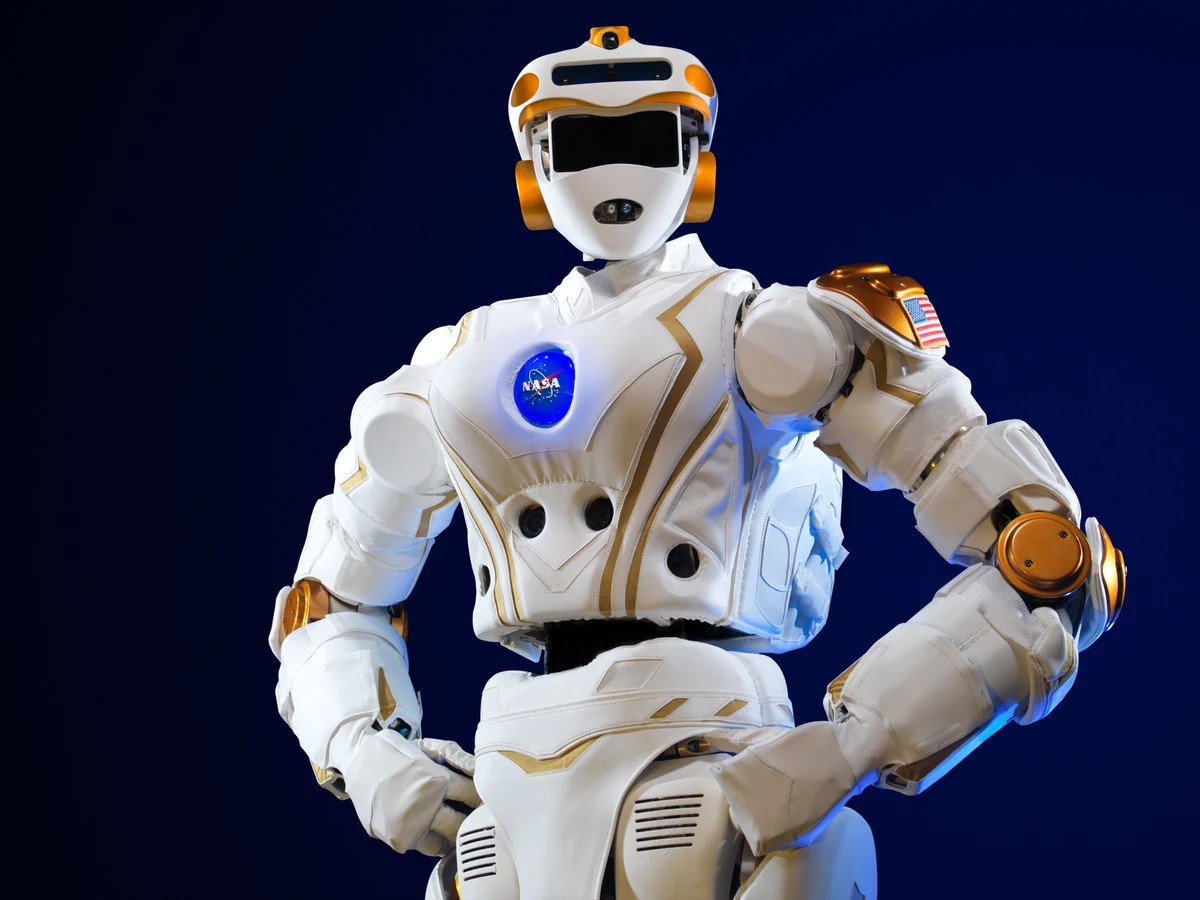
Valkyrie (R5), photographed December 12, 2013. Historical research hardware.

Photo: NASA/JSC, Bill Stafford. Valkyrie, December 2013. Historical research hardware. Image source (opens in a new tab) Photo license (opens in a new tab)

Also called R5, this electric humanoid brings legs, arms and hands together for demanding environments.1

Before you choose

What is Valkyrie for?

NASA developed Valkyrie, also called R5, for the 2013 DARPA Robotics Challenge Trials and work in damaged human-engineered environments. It is a whole-body research platform, with hands and arms as well as two legs.

Source(opens in a new tab)

Which Valkyrie specifications can I compare?

NASA’s 2015 profile lists 6 feet 2 inches, 300 pounds, 44 degrees of freedom and a 1.8 kWh battery. Those values belong to that documented historical configuration. They are not a specification for every later unit, and battery capacity is not a verified operating duration.

Source(opens in a new tab)

Did Edinburgh’s return mean Valkyrie was retired?

The University of Edinburgh’s account concerns its own unit after a ten-year lease beginning in 2016. It does not establish retirement of the whole program. NASA’s September 2026 team feature separately includes a Valkyrie demonstration.

Source(opens in a new tab)Source(opens in a new tab)

Can I buy Valkyrie for a home?

The examined NASA and partner research sources do not establish a household sale or ownership package. Domestic setup, maintenance, service, subscription and data-handling terms remain unknown. This record is for understanding the research.

Source(opens in a new tab)

Does its humanlike shape mean it can work around children?

The sources do not establish household or child-safety certification or unsupervised home capability. Ask what a demonstration actually shows about the task, supervision and stopping the machine. The 300-pound figure describes the 2015 configuration, rather than a home-safety assessment.

Source(opens in a new tab)

How is Valkyrie different from Robonaut 2?

Valkyrie is an electric bipedal humanoid developed for whole-body work. R2’s original flight configuration concentrated on a head, torso and arms, with climbing legs added later. Both belong to NASA research; NASA is a United States civilian government agency, rather than a robot retailer.

Source(opens in a new tab)Source(opens in a new tab)Source(opens in a new tab)

The robot and the research

Valkyrie explores a problem that a robot arm alone cannot solve: reaching the job, keeping its balance and using its hands when the surroundings were built for people. NASA developed the bipedal robot for the 2013 DARPA Robotics Challenge Trials. Its place in this directory is as a research platform, with a history of development and collaboration.1Inferred

Built for a difficult environment

Johnson Space Center's Engineering Directorate designed and built Valkyrie over 15 months, drawing on earlier Robonaut experience. NASA subsequently changed its hands, ankles and sensors and worked with the Florida Institute for Human and Machine Cognition on walking algorithms. The name describes an evolving research platform, not one fixed consumer package.1

NASA's 2015 profile lists a height of 6 feet 2 inches, a weight of 300 pounds, 44 degrees of freedom and a 1.8 kWh battery. These are historical specifications for that documented configuration. They help convey the scale of the machine without pretending that every later Valkyrie has an identical bill of parts.1

A continuing research history

The University of Edinburgh’s account says its Valkyrie returns to NASA after a ten-year lease that began in 2016. The end of that placement concerns one unit, rather than establishing that every Valkyrie has retired. Keep the history of that particular research placement separate from the wider program.2

NASA's September 2026 feature also shows Valkyrie in a demonstration and describes the agency's current dexterous robotics work. Together, these accounts place the robot in an ongoing research lineage. They do not turn it into a purchasable home assistant or establish a new spaceflight deployment.31Inferred

What to notice before imagining one at home

Think about a specific household job, such as moving a bag from the floor to a shelf. How much room would the robot need to turn? Could someone stop it easily, and how would it recover from losing balance? Those questions are more useful than judging readiness from a humanlike outline. The published weight alone makes the scale of the interaction worth considering.1

The examined research sources do not establish a domestic ownership package for Valkyrie. Installation, maintenance and privacy terms for a family purchase remain unknown. Robonaut 2 offers a related view of dexterity, while NASA’s civilian government research role explains the setting for both projects.14Inferred

NASA’s role

NASA is a United States civilian government research and exploration organization. Its dexterous-robotics work investigates manipulation for human spaceflight. That context describes these research programs; it does not establish a household sale or make NASA a privately owned or publicly traded robot company.43

Explore further

Sources and notes

  1. 1. NASA R5 technical profile

    The September 2015 R5 technical profile supplies the historical size, weight, battery capacity and joint count. Its configuration is not a new commercial specification. Evidence dates and retrieval limits are retained from the cited research. This profile reports source accounts rather than our own hardware testing.Inferred

    Evidence checked: 2026-10-26

  2. 2. Valkyrie concludes a decade at Edinburgh

    The University of Edinburgh account concerns the return of its own Valkyrie after a ten-year lease, rather than retirement of all Valkyrie units. Only the indexed passage was inspected in the retained research; direct retrieval returned 403. The claim concerns Edinburgh’s own unit. Evidence dates and retrieval limits are retained from the cited research. This profile reports source accounts rather than our own hardware testing.

    Evidence checked: 2026-10-26

  3. 3. Reliable Robots: Johnson's Dexterous Robotics Team

    NASA’s September 2026 team feature describes dexterous-robotics research and includes Valkyrie. It does not establish that R2 returned to orbit or that either robot is a household product. Evidence dates and retrieval limits are retained from the cited research. This profile reports source accounts rather than our own hardware testing.

    Evidence checked: 2026-10-26

  4. 4. NASA origins

    NASA’s historical account separates the July 29, 1958 legislation from the October 1 start of operations and describes its civilian government origins. Evidence dates and retrieval limits are retained from the cited research. This profile reports source accounts rather than our own hardware testing.

    Evidence checked: 2026-10-26

  5. 5. Robonaut 2 program

    NASA’s program page documents the NASA and General Motors collaboration, the flight mission and the later climbing-leg upgrade. The original torso assembly and legged upgrade are separate configurations. Use the 2011 to 2018 residency from NASA’s later retrospective; launch-era resident wording is not a current location report. Evidence dates and retrieval limits are retained from the cited research. This profile reports source accounts rather than our own hardware testing.

    Evidence checked: 2026-10-26

What does degrees of freedom mean?