From a legged experiment to several configurations
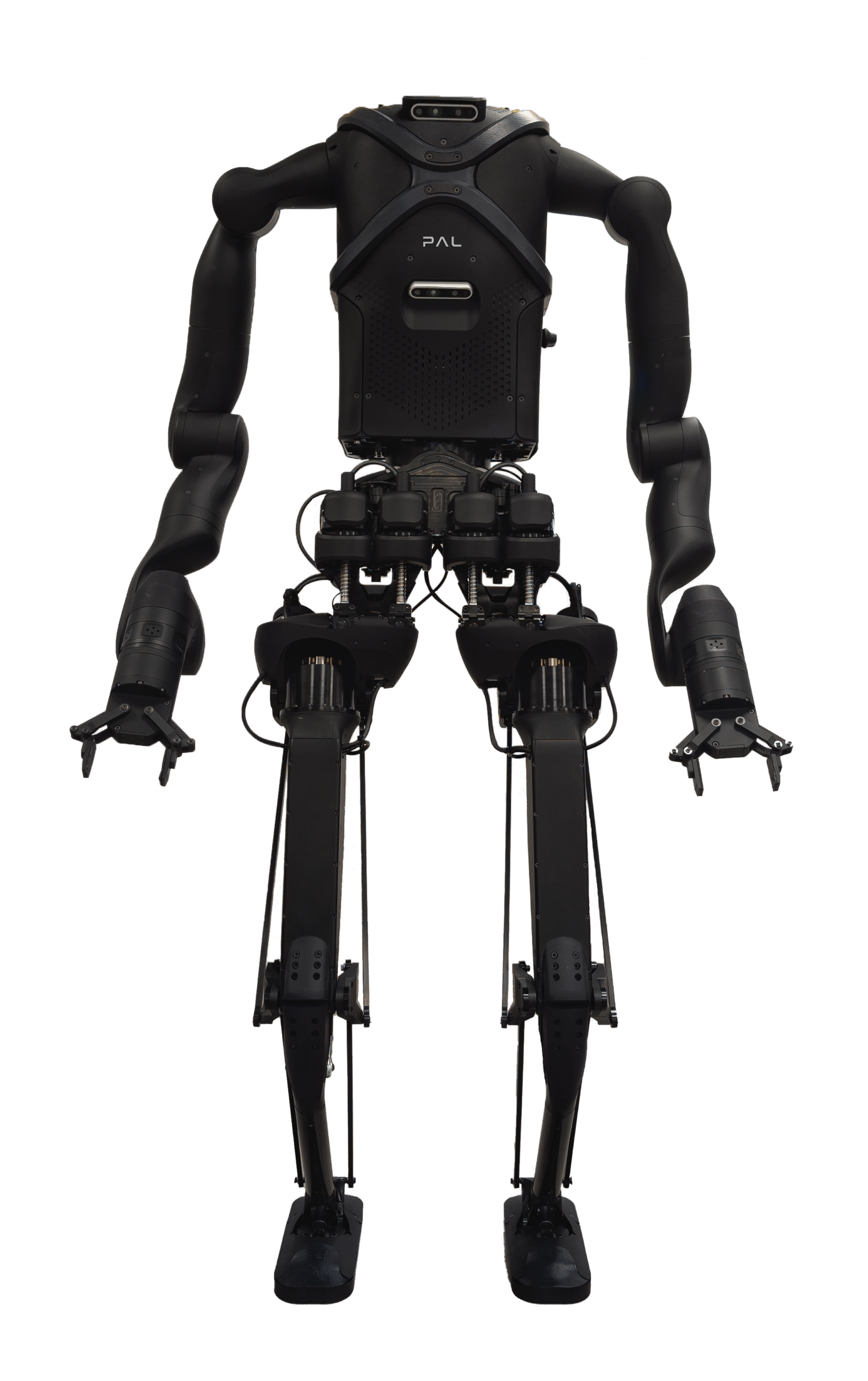
PAL dates the first Kangaroo program to 2021. Its early development account explains the emphasis on low-inertia legs and custom linear actuation, with the aim of handling dynamic movements and impacts. By 2025, its timeline described two sale versions, including Kangaroo Pro with arms.14
The product page checked on October 26, 2026 lists a height of 160 cm, a configuration-dependent weight of 50 to 65 kg, and 14 to 40 degrees of freedom. Four-, five- and seven-degree-of-freedom arm options have respective fully extended payload ratings of 7, 5 and 3 kg. Those are separate choices, so the highest joint count and highest arm payload cannot be combined into one assumed specification.3
What a research team works with
The software list includes Ubuntu LTS, ROS 2 LTS, PAL OS and ros2_control, alongside MuJoCo, mjlab and URDF/MJCF models for simulation and development. GPU computing and force or torque sensing and control have optional configurations. Tie the exact body, sensors, computing and software to the quotation so the demonstration reflects the system being purchased.3
PAL reported a Kangaroo locomotion demonstration at the European Parliament's euROBIN event in September 2026. That is a useful milestone in the platform's research story. It does not by itself specify what a new buyer receives, how an experiment is supervised or what performance will be repeatable in another setting.23
Start with the movement problem
A laboratory studying balance may value access to control and sensing more than a sophisticated hand. A manipulation project may need an arm configuration with the right reach and payload instead. Write down the required movement, load and workspace before choosing the package; otherwise the highest number in a specification table can be a distraction.3
For projects motivated by home assistance, ask how the robot recovers when it cannot complete the intended movement and what equipment or staff must remain nearby. Price, runtime for the chosen experiment and the local support arrangement should be confirmed in the quotation.3
Does the seven-degree-of-freedom arm lift the most?
No. PAL lists 3 kg with the seven-degree-of-freedom arm fully extended, compared with 5 kg for the five-degree-of-freedom option and 7 kg for the four-degree-of-freedom option. More independent movements do not mean a higher extended-arm load. Choose around the required motion and load, then confirm the complete configuration with PAL.3
How long can the current KANGAROO run?
A battery duration for the current configuration is not established by the cited material. Obtain a workload-specific figure for the body, arms and computing selected in the quotation, along with charging and session setup requirements. An earlier version’s duration should not set the plan for a new research system.3
KANGAROO body configurations
PAL KANGAROO · Product-page configuration range, October 26, 2026 · Delivery countries not established
Weight and joint count vary with the configured platform. These ranges are not a promise that one configuration has every listed feature.3
- Listed height
- 160 cmCurrent product-page specification; not the dimensions of the 2021 prototype.3
- Weight range
- 50 to 65 kgDepends on configuration.3
- Degrees of freedom
- 14 to 40Configuration-dependent count of independent movements.3
4-degree-of-freedom arm option
PAL KANGAROO · 4-degree-of-freedom arm, October 26, 2026 · Delivery countries not established
PAL lists this arm and its fully extended payload as one configuration choice. It is separate from the other arm options.3
- Arm degrees of freedom
- 4Independent arm movements in this option.3
- Payload with arm fully extended
- 7 kgRating for this arm option only. No combined two-arm rating is inferred.3
5-degree-of-freedom arm option
PAL KANGAROO · 5-degree-of-freedom arm, October 26, 2026 · Delivery countries not established
PAL lists this arm and its fully extended payload as one configuration choice. It is separate from the other arm options.3
- Arm degrees of freedom
- 5Independent arm movements in this option.3
- Payload with arm fully extended
- 5 kgRating for this arm option only. No combined two-arm rating is inferred.3
7-degree-of-freedom arm option
PAL KANGAROO · 7-degree-of-freedom arm, October 26, 2026 · Delivery countries not established
PAL lists this arm and its fully extended payload as one configuration choice. It is separate from the other arm options.3
- Arm degrees of freedom
- 7Independent arm movements in this option.3
- Payload with arm fully extended
- 3 kgRating for this arm option only. No combined two-arm rating is inferred.3
Sources and notes
- 1. PAL: KANGAROO development timeline
PAL dates the initial KANGAROO platform to 2021 and describes KANGAROO and an armed Pro version in 2025. These milestones do not identify the hardware revision or package in a new quotation.
Evidence checked: 2026-10-26
- 2. PAL: euROBIN demonstration
PAL reported a KANGAROO movement demonstration at the European Parliament on September 2, 2026. That event does not establish repeatable performance for a different configuration or a new buyer’s experiment.
Evidence checked: 2026-10-26
- 3. PAL: KANGAROO configurations
The October 26, 2026 page lists configuration-dependent weight and joint-count ranges. Four-, five- and seven-degree-of-freedom arms have different fully extended payload ratings. No maximum is assigned to all versions, and no combined two-arm lifting figure is inferred. A current battery duration and fixed price remain unknown.
Evidence checked: 2026-10-26
- 4. PAL: early KANGAROO mechanism
This early development account explains the leg design and its intended response to dynamic movement and impacts. It is not an unconditional fall-resistance claim or the specification of every later full-body configuration.
Evidence checked: 2026-10-26