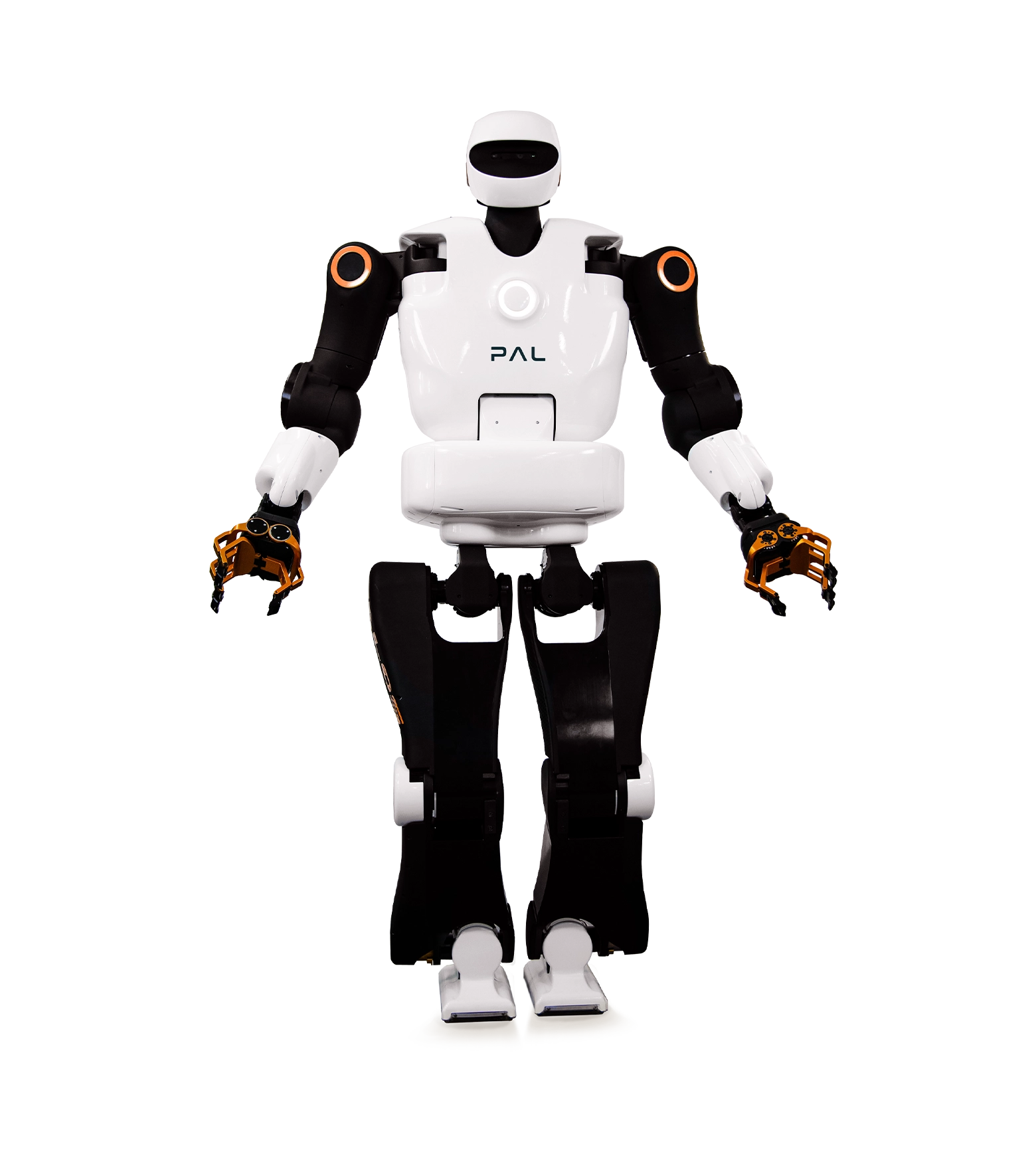
Why TALOS exists
PAL announced TALOS in October 2016 following a LAAS-CNRS tender. The first machine, called PYRENE, was presented at LAAS-CNRS in February 2017 for research into navigation, movement and interaction with its surroundings.32
The resulting platform combines walking with substantial arms. PAL lists a height of 175 cm, a weight of 95 kg and a payload of 6 kg per arm when fully extended. These figures help a laboratory plan equipment and workspace; they are not a claim that the robot can safely lift any household object in any pose.1
Control and practical limits
TALOS provides torque feedback so developers can work with the forces at its joints. PAL's detailed specification excludes the head, wrists and grippers from the otherwise broad joint-sensor description. Its published battery figures distinguish 1.5 hours of walking from three hours on standby.1
TALOS lists ROS development, Ubuntu LTS, a real-time operating system and a simulation model. PAL separately advertises extra software for whole-body control, navigation, interaction with people and remote operation. Agree which software is supplied along with the head and grippers before comparing quotations.1
What to ask before ordering
The current route is a request for a quotation. Define the experiment first: for example, carrying a specified tool while stepping over a known obstacle. Then agree the required payload posture, operating area, emergency procedure and staff training. That turns a broad humanoid specification into a system that can be evaluated against a real purpose.1
A home-assistance project needs an equally precise brief, including supervision, recovery and data handling. Current public material does not establish a consumer warranty, local repair arrangement or a ready-made domestic service package. Those are questions for the quotation, not capabilities to assume from a laboratory demonstration.1